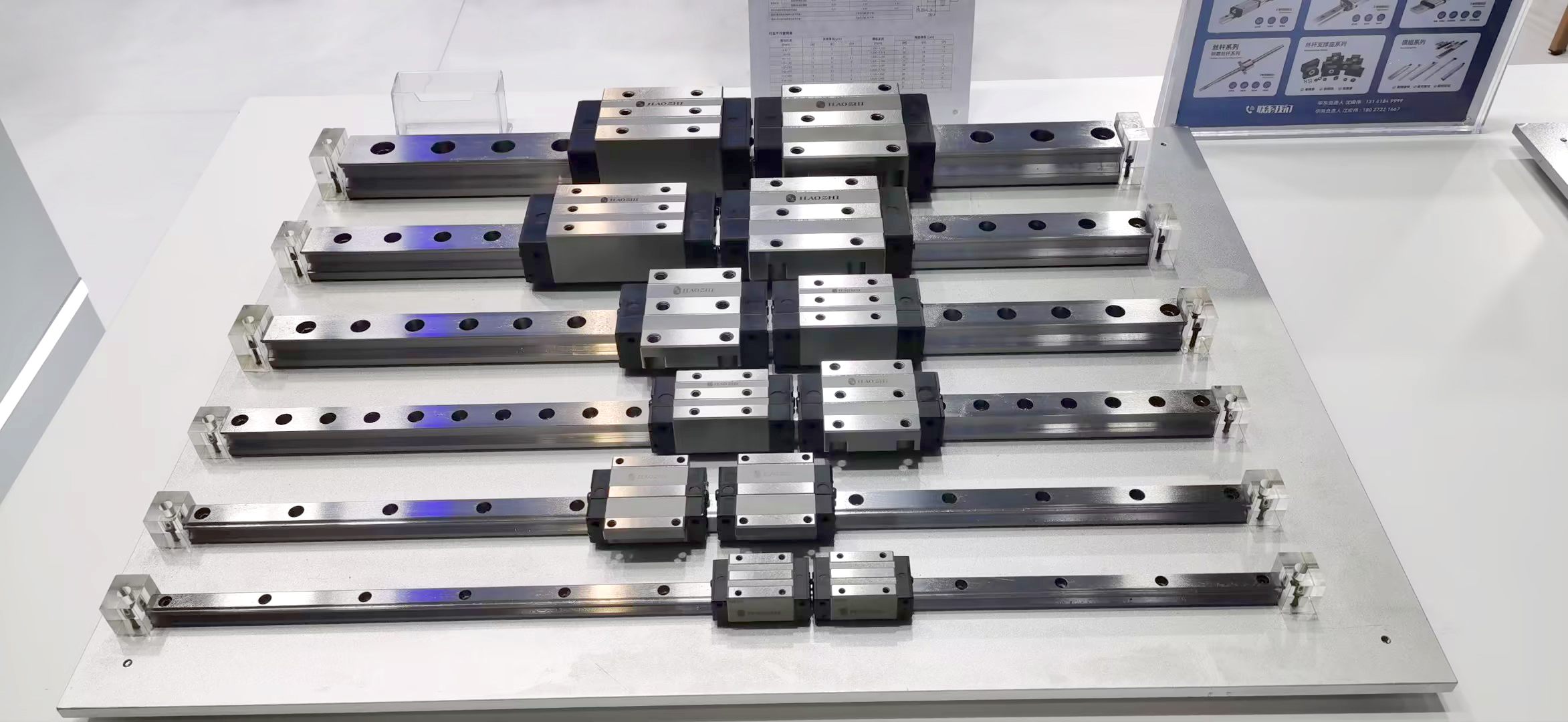
What Is a Linear Rail?
A linear rail does three jobs in a machine:
Guides motion. It permits travel along one axis and blocks the other five degrees of freedom.
Carries load. It supports the weight of the moving mass, process forces and the reaction forces from acceleration.
Holds straightness and repeatability. Because the carriage runs on ground raceways, the same stretch of travel behaves the same way on every pass.
On a CNC machine, a rail pair under a table or saddle sets how straight the axis moves and how stiff it feels under cutting load.
Rail, guide, guideway, slide: what the words usually mean
The industry uses these words loosely. The table shows what each term usually means and how far it can be swapped for another.
| Term | What it usually means | Interchangeable with "linear rail"? |
|---|
| Linear rail | The track itself, or in casual use the whole rail-and-carriage system | Yes, in everyday use |
| Linear guide | The full system: rail, carriage (block), rolling elements, seals | Mostly yes; "guide" stresses the whole assembly |
| Linear guideway | Same as linear guide; common in Asian and European catalogs | Yes |
| Linear slide | Often a pre-assembled stage or table with a base, a moving platform and a guide inside | Not always; a slide is a finished unit, a rail is a component |
| Linear bearing | The bearing element, such as a ball bushing on a round shaft | No; it is one part of a guide, not the track |
When you specify parts, name the format rather than the word. "Profile rail with flanged ball carriage" is unambiguous. "Linear rail" alone is not.
What Is a Linear Guide?
"Linear guide" usually names the whole system. It covers the rail, the carriage or block, the rolling elements and the seals and lubrication ports that keep it running. "Rail" often names only the track. In most catalogs the two refer to the same product family.
Two differences are worth knowing:
A slide is frequently a complete stage. It is a base, a platform and a guide delivered as one unit, ready to bolt on and drive. Machine builders who want ready-to-mount axes often look at linear slides for CNC and automation axes rather than loose rails.
A guideway is the same hardware under a different regional label.
A guide constrains motion but does not create it. For CNC machine builders, the guide is normally specified together with the drive, so catalogs often group linear guide and ball screw systems for CNC in a single product family.
How a Linear Rail Works
The parts: rail, carriage, rolling elements
A profile rail system has four functional groups:
Rail. A hardened, ground steel profile with raceways along its sides, drilled for mounting bolts.
Carriage (block). A steel body that wraps the rail and holds the rolling elements.
Rolling elements. Balls or rollers that carry load between the raceways. In a recirculating design they travel through a return channel in the carriage, so the carriage can run the full length of the rail.
End caps, seals and lubrication ports. These keep contamination out and grease in. Wiper seals and bottom seals are common options.
Non-recirculating designs, such as some crossed roller guides, have a limited stroke because the rolling elements travel at half the carriage's speed and never complete a loop.
The simplified cross-section below shows how the carriage wraps the rail. The rolling elements sit in raceway rows on both sides, so the same contact geometry resists downward, upward and sideways loads.
┌───────────────────────────┐ │ CARRIAGE │ ← mounting holes in top face │ ● ● │ ← upper raceway rows └──┐ ┌──┘ │ RAIL │ │ ● ● │ ← lower raceway rows │ │ ──────────┴─────────────────────┴────────── flat, rigid mounting surface
Simplified profile-rail cross-section. Real profiles vary by series, with different raceway angles and 2 or 4 ball or roller rows.
Preload, stiffness and smoothness
Preload means the rolling elements are fitted with a slight interference, so there is no clearance in the contact zone. That removes play and raises stiffness, which matters when cutting forces try to push the carriage around. The cost is more friction, more heat and a shorter fatigue life at the same load.
Preload is expressed as a fraction of the dynamic load rating C. Catalog classes typically run from a light preload of roughly 2% C up to a heavy preload of roughly 8% C, with a clearance or zero-preload class below that. Light preload suits smooth, fast, low-force axes. Heavier preload suits machine tools that take cutting loads. Class names differ between brands, so read the percentages in the maker's own catalog rather than comparing labels across catalogs.
Load directions and moments
A carriage sees more than a downward load. Designers check:
Radial load: pressing the carriage onto the rail.
Reverse-radial load: pulling it away from the rail, as in an inverted mount.
Lateral load: pushing it sideways.
Moment loads: rotational loads about three axes, usually called pitch, yaw and roll.
Moments matter more than most first-time buyers expect. A tool head hanging off the front of a saddle, or a gantry carrying a long overhang, puts a large moment on the carriages even when the weight is modest. Spacing the carriages further apart, or using more carriages per rail, is often the cheapest fix.
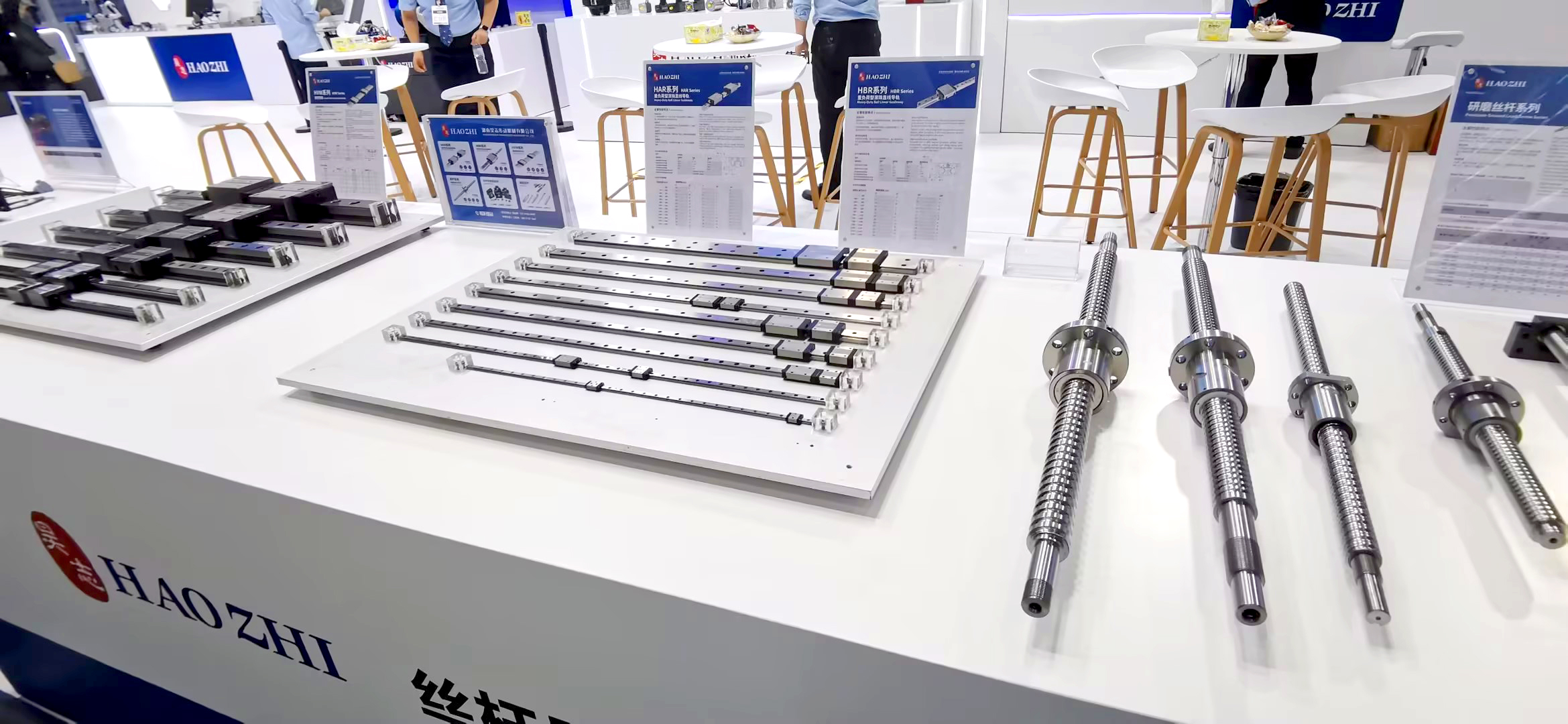
What Are the Different Types of Linear Guides?
The types differ mainly in rolling element and profile. The table sorts them by what actually separates them.
| Type | Rolling element | Typical strength | Typical limitation | Typical use |
|---|
| Profile rail, ball type | Recirculating balls | Smooth, accurate, widely available | Lower rigidity than roller types at the same size | General CNC and automation axes |
| Profile rail, roller type | Recirculating rollers | Higher rigidity and load capacity in the same envelope | Slightly more friction, less forgiving of mounting error | Machine tool axes with heavy cutting loads |
| Crossed roller guide | Rollers crossed at 90° | Compact, very rigid for its size | Short stroke, non-recirculating | Stages, measuring and inspection equipment |
| Cam roller / V-groove / track roller | Bearings rolling on a profile | Tolerates dirt and some misalignment | Lower precision and stiffness than profile rails | Packaging, material handling, dirty environments |
| Round shaft with linear ball bushing | Balls in a bushing | Cheap, simple, easy to align | Shaft deflects, support is limited | 3D printers, light equipment |
| Plain guide (dovetail, boxway, sleeve) | Sliding contact | Damping, heavy-load capacity | Higher friction, needs scraping or lubrication care | Some machine tool beds, heavy machines |
| Low-profile, wide, miniature profile | Balls or rollers | Fits tight envelopes, handles moments | Smaller load ratings | Compact axes, electronics, medical devices |
Profile rail, ball type
This is the standard choice when you want smooth motion with good accuracy. Balls make point contact with the raceway, which keeps friction low and speed high. Heavy-duty ball series extend that design to larger frames. The HAR heavy-duty ball linear guides are an example of this category in Haozhi's catalog.
Profile rail, roller type
Rollers contact the raceway along a line instead of at a point. At the same size that gives higher rigidity and load capacity, which is why roller guides appear on machine tool axes that take real cutting forces. The trade-off is more friction and tighter demands on mounting-surface flatness. See the HBR heavy-duty roller linear guideways for the roller category in the catalog.
Crossed roller guides
Two sets of rollers sit at right angles inside a V-groove, so each roller carries load in one direction. The result is a very compact, rigid guide. Because the rollers usually do not recirculate, stroke is limited to a fraction of the rail length.
Cam roller, V-groove and track-roller guides
These use rolling bearings running on a hardened track, often a U-shaped or V-shaped steel profile. They tolerate dirt and a degree of misalignment better than a profile rail, which suits packaging lines and workshop equipment. They are not the first pick when you need the stiffness of a machine tool axis.
Round-shaft guides with linear ball bushings
Round linear rail means a hardened shaft running through a ball bushing. It is inexpensive and simple, and it forgives small alignment errors. The limit is support: a shaft with no continuous backing can deflect under load, and the contact area is small, so it works best on lighter axes such as 3D printers and small routers.
Plain and sliding guides: dovetail, boxway, sleeve
Sliding guides use surface-to-surface contact, usually lubricated, instead of rolling elements. Friction is higher, but contact area is large, so damping and heavy-load capacity are excellent. That is why boxways remain on some large machine tool beds, where vibration damping matters more than low friction.
Low-profile, wide and miniature variants
A low-profile rail lowers the stack height for space-limited designs. A wide rail spreads the load across a broader base and improves moment capacity. Miniature rails serve electronics, medical and inspection equipment. The HVW wide miniature linear guideways are an example of this category.
Guide versus drive: where ball screws and motors fit
A ball screw is a drive, not a guide type. It converts rotation into linear force, while the rail constrains where the carriage can go. A complete linear module combines both, along with a motor and usually a coupling and bearing supports.
Ball screw plus rail: the usual combination for precise, stiff axes. The ball screw guide explains that side.
Belt or rack drive plus rail: common for long travel and lighter loads.
Linear motor plus rail: the motor pushes the carriage directly, with no mechanical transmission. The linear motor guide covers it.
The rail choice and the drive choice are separate decisions, though they interact through speed, stiffness and travel.
How Much Weight Can a Linear Rail Hold?
There is no single number. Capacity depends on the rail size and series, whether the rolling elements are balls or rollers, how many carriages share the load, the mounting orientation and the direction of the load. A datasheet rating for one carriage says little until you know how the load actually acts on it.
Three ideas make the datasheet readable:
Static load rating is the load a carriage can sit under without permanent raceway deformation. It matters for shock and standstill loads.
Dynamic load rating (C) is the load at which a reference group of identical guides reaches a defined travel distance before fatigue. It drives service life.
Safe working load is what you actually apply. It is always well below the ratings, once you include safety factors, shock, and the equivalent combined load from forces and moments.
A worked L10 life example
Rated life follows a power law. For ball guides, with the common 50 km reference distance:
L10 = 50 km × (C / P)³
where P is the equivalent load on the carriage. Roller guides use an exponent of 10/3 instead of 3, and some makers use a 100 km reference, so check the convention in the maker's catalog.
Illustration with round numbers: a ball carriage with C = 20 kN carrying an equivalent load P = 5 kN gives (20 / 5)³ = 64, so L10 = 64 × 50 km = 3,200 km. On an axis with a 0.5 m stroke, each round trip covers 1 m, so that is about 3.2 million cycles. Now raise the load to P = 8 kN. The ratio drops to 2.5, the cube is about 15.6, and L10 falls to roughly 780 km. A 60% increase in load cuts calculated life by about three quarters. These figures illustrate the formula only. They are not ratings for any specific product.
Moments often limit a design before straight radial load does. A moving mass hanging off the side or front of the carriage can approach the moment rating while the radial load is still comfortable. Check pitch, yaw and roll ratings against the real overhang, not only the weight.
What to check on a datasheet:
Dynamic and static radial ratings per carriage.
Permissible static moments in all three directions.
The reference distance used for the dynamic rating, which differs between makers.
Preload classes, from roughly 2% to 8% of C, and their effect on the rating.
Accuracy grade for running parallelism and height tolerance (see the sizing section below).
Mounting orientation limits, including inverted and vertical.
What Is a Linear Rail Used For?
Linear rails appear wherever a load must move along a line with controlled accuracy:
CNC machine tools: table, saddle, column and spindle-head axes.
3D printers and routers: lighter axes, often with round shafts or small profile rails.
Robotics and gantries: seventh-axis tracks and pick-and-place beams.
Packaging and material handling: shuttles, pushers and transfer axes.
Semiconductor and inspection equipment: low-profile and miniature guides with tight straightness needs.
Tool-grinding machines: grinders pair a rotary head with linear axes that position the head and workpiece along the grinding path. Rotary components such as the DZDC-125 cradle tool grinding rotary head and the DZGD-180A35 tool grinding table with tailstock handle the rotary motion, while the linear options for the other axes are specified separately.
Rails can run horizontally, vertically or inverted. On a vertical axis, a ball-type guide has so little friction that the load can fall when the drive is unpowered. Vertical axes therefore normally need a brake, a counterbalance or a self-holding drive.
Advantages and Limitations of Linear Rails
Advantages
Low friction and smooth motion, with little stick-slip.
High repeatability, because the raceways are ground.
High rigidity for the size, especially with roller types and preload.
Standardized dimensions, so carriages and rails from one series interchange.
Long travel through butt-joined rail sections.
Limitations
They need a flat, rigid mounting surface. A weak or wavy base shows up as roughness or shortened life.
Contamination damages raceways unless seals and wipers are fitted and maintained.
Tolerance for misalignment is limited, particularly in preloaded roller types.
Rolling guides damp vibration less than sliding guides.
They constrain motion but do not drive it, so a drive must be added.
How to Choose the Right Linear Rail
Work through these questions in order:
Load and moments: what forces and overhangs does each carriage see, including during acceleration and cutting?
Rigidity: how much deflection can the process tolerate?
Accuracy and travel: how long is the stroke, and what straightness is needed over it?
Speed and acceleration: ball types usually favor speed and lower friction.
Environment: coolant, chips, dust, washdown or clean room?
Mounting surface: is it ground or machined flat, and how stiff is the structure?
Budget and availability: including the cost of the surface preparation underneath.
| If your priority is… | Consider… |
|---|
| Smooth, fast, accurate motion | Ball-type profile rail |
| Maximum rigidity in a given frame size | Roller-type profile rail |
| Very compact, stiff, short stroke | Crossed roller guide |
| Dirt tolerance and forgiving alignment | Cam roller or V-groove guide |
| Lowest cost, light load | Round shaft with ball bushings |
| Vibration damping on heavy machines | Boxway or other plain guide |
| Tight height or width envelope | Low-profile, wide or miniature profile rail |
Sizes, accuracy grades and preload
Profile rail sizes are set by the maker's designation, which roughly tracks rail width. Common sizes run from 15 to 45 mm (typically 15, 20, 25, 30, 35 and 45), with larger frames above that for heavy machines and miniature series below. Designations are not standardized across brands, so confirm dimensions on the drawing before you order. Within a size, the carriage can be a standard, long or flanged body, and the load rating rises with each step up in length.
Accuracy is graded within each size. A typical ladder runs N (normal), H (high), P (precision) and SP (super precision), with the grade setting the tolerance on running parallelism and mounting-height variation. Higher grades cost more and demand a better mounting surface, so grade the axis to what the process needs. Choose preload from the same logic: roughly 2% C for smooth, light-force motion and up toward 8% C where stiffness under cutting load decides the result. Grade letters and preload labels vary between makers, so compare numeric tolerances and percentages.
Cost and kits
Rails are expensive mainly because of the grinding, hardening and tolerance control behind each profile, plus the cost of long precision lengths. Cheap rails are easy to find through catalog distributors and online marketplaces, but low price usually reflects looser tolerances, lighter preload options or limited documentation. For a closer look at what drives price, read about linear rail cost.
A linear rail kit is a rail with carriages and end hardware sold together. Check that the kit lists load ratings and accuracy grade, not only a length and a width.
If you are weighing roller against ball for a specific axis, send us the axis details and we can help compare options.
Installation, Lubrication and Service Life Basics
Surface flatness: the mounting surface is part of the guide. Machine it flat and parallel to the tolerance the maker specifies, because a rail will follow whatever shape it is bolted to.
Follow the instructions: use the maker's bolt torque and alignment procedure, including any reference edge. Guessing torque is a common cause of early wear.
Lubrication: grease or oil through the carriage ports at the interval the maker recommends. Replace damaged seals promptly, since contamination ends rail life faster than load does.
Rated life (L10): this is the distance that 90% of identical guides are expected to reach or exceed before fatigue shows. It is a statistical figure under the stated conditions, not a guarantee for a single guide. Real service life also depends on lubrication, contamination, shock and installation quality.
Choosing Linear Guides for CNC Machines
For CNC axes, the usual route is to match the guide type to the axis. Roller types suit heavy cutting axes. Ball types suit faster, lighter axes. Wide or miniature profiles suit compact designs. Then fix the drive and the number of carriages.
Haozhi supplies component families for machine builders. They include linear guide and ball screw systems, with the HAR, HBR and HVW families as the places to start. Send us the axis stroke, load, overhang and environment, and we will help narrow the options. Request a technical consultation.
Linear Rail FAQ
What is a linear rail used for?
A linear rail guides a load along a straight line with low friction. Typical uses include CNC machine tool axes, 3D printers, robotic gantries, packaging machinery, semiconductor and inspection equipment, and tool-grinding machines. It supports the load and keeps travel straight and repeatable, while a separate drive provides the motion.
Why are linear rails so expensive?
Precision profile rails need hardened, ground raceways, tight tolerances along the full length, and matched carriages with recirculating rolling elements. Longer lengths, higher accuracy grades, roller designs and corrosion treatments add cost. The mounting surface underneath also has to be machined flat, which adds expense.
Where can I get cheap linear rails?
Catalog distributors, industrial supply sites and online marketplaces sell low-cost rails and kits, mostly round-shaft and small profile types. Low price usually means lighter preload options, looser accuracy grades or limited documentation. For machine tool axes, compare load ratings and accuracy grades, not just price.
How much weight can a linear rail hold?
It depends on rail size and series, ball or roller design, the number of carriages, mounting orientation and load direction. Read the static and dynamic ratings per carriage, then check the moment ratings against your real overhang. The safe working load is always well below the rating.
What is the difference between a linear rail and a linear slide?
A linear rail is a component: a track and carriage. A linear slide is usually a complete stage with a base, a moving platform and a guide inside, delivered as one unit. Slides save design time for light and medium axes. Rails give a machine builder freedom to set spacing, stiffness and mounting.
Ball vs. roller linear rails: which should I choose?
Choose ball-type rails for smooth, fast, accurate motion with lower friction. Choose roller-type rails when rigidity and load capacity matter more, such as heavy cutting axes. Rollers are stiffer in the same frame size but add friction and demand a flatter mounting surface.
Can linear rails be used vertically?
Yes. Profile rails can run horizontally, vertically or inverted, provided the maker's orientation limits are respected. Because rolling guides have very low friction, a vertical axis can fall when power is lost. Add a brake, a counterbalance or a self-holding drive.
There is no fixed figure. Life is calculated from the dynamic load rating and the equivalent applied load, and L10 is the distance that 90% of identical guides should reach. Lubrication, seal condition, contamination, shock loads and installation accuracy often decide actual service life more than the rating does.

 Home