What Is a CNC Spindle?
A CNC spindle is the rotating shaft together with the parts that support, power and equip it: bearings, a drive, and an interface that holds the tool or workpiece. It sets three things the rest of the machine cannot make up for: how fast the cutter turns, how much torque it has, and how accurately it runs.
On the shop floor, "spindle" often means the whole rotary unit rather than just the steel shaft. "Replace the spindle" usually means the shaft, bearings and attached parts as one assembly.
The spindle is where cutting happens. Axis motors move the tool into position, and the spindle does the work once it gets there.
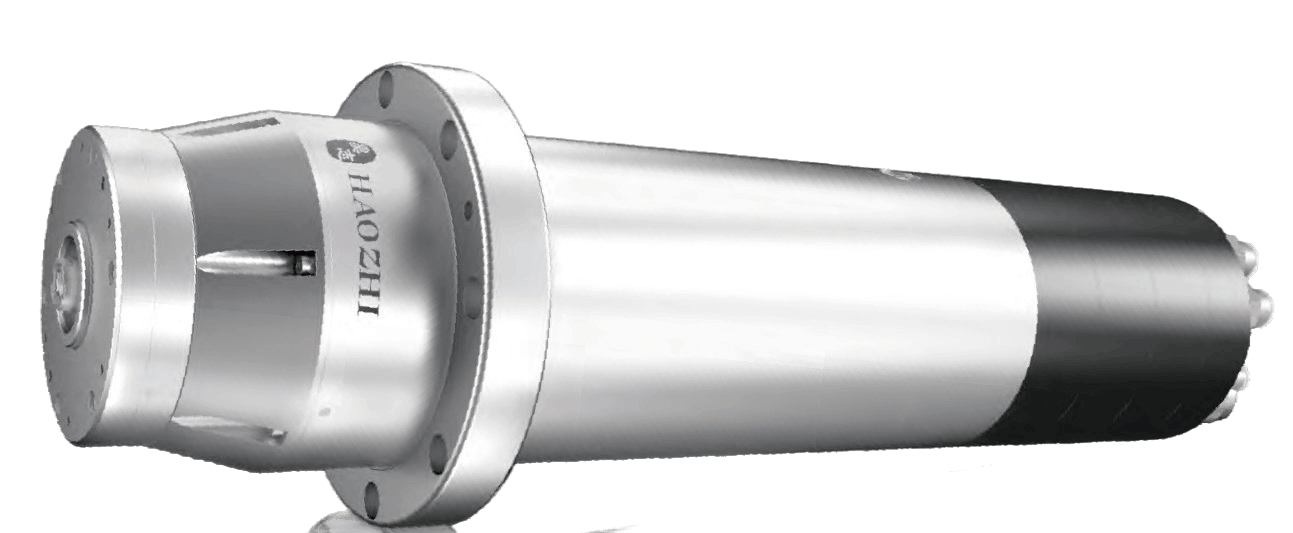
What Is a Spindle on a CNC Machine?
On a CNC machine, the spindle is the rotating unit that turns the tool or the part. Which one it turns depends on the machine.
Mills and routers
The spindle spins the cutting tool. The workpiece stays clamped to the table while a drill bit, end mill, router bit or grinding wheel rotates in the spindle's tool interface. Some machines use a torque-motor milling head as the rotary cutting unit. The torque-motor milling head with an HSK-T63 interface and 810 Nm of torque is one example.
Lathes
The roles reverse. The headstock spindle holds and rotates the workpiece through a chuck or collet while the tool stays on the carriage or turret. On longer parts, the tailstock supports the free end. It does this through the tailstock quill, the sliding barrel that carries a center. A live center turns with the workpiece on its own bearings. A dead center is fixed and does not rotate, so the work spins against it and the contact point needs lubrication. Only the headstock spindle is driven.
Multi-spindle machines
Some high-volume machines carry four, six or more main spindles so several parts are cut at once. Unless a drawing says otherwise, "the spindle" means the main spindle.
Main Parts of a CNC Spindle
Each part changes something you will see in performance:
Shaft: the rotating core. Its diameter and stiffness influence how much cutting load it takes without deflecting.
Bearings: ball bearings, air bearings or hydrostatic (fluid-film) bearings. They determine speed capability, stiffness and rotation accuracy. Bearing life depends mainly on load, speed, preload, lubrication, contamination and heat.
Drive: a belt, a coupling to an external motor, or a motor built into the spindle. This sets the speed and torque range.
Tool interface and clamping: the taper or collet that holds the tool, such as HSK, BBT or ER. It must match your tool holders and, on machining centers, the tool-change system. A drawbar normally pulls the holder taper into the spindle. If clamping force is too low for the holder, you get tool slip, extra runout and a poorer finish, so take the required force from the spindle and holder specifications.
Cooling: air or liquid, which controls how much heat the spindle builds up during long runs.
Feedback: an encoder reports speed and position, which matters for tapping, synchronization and orientation.
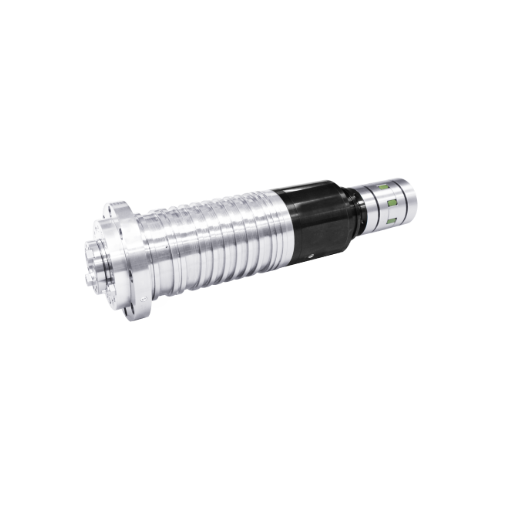
What Are the Different Types of CNC Spindles?
Spindles are classified by how they are driven, by what the shaft rides on, and by the job they do. Cooling method is a fourth, simpler split. The table sets general, commonly cited speed ranges beside the ranges of Haozhi catalog models in each family. The catalog figures are what these models actually list, not universal limits, and the general column varies with design.
| Classification | Type | General typical speed | Haozhi catalog range | Main trade-off |
|---|
| Drive | Belt-driven | Roughly 12,000–15,000 rpm maximum | 6,000–10,000 rpm (BT40 and BT50 models) | The external motor is easy to change for more power or torque; the belt system limits top speed |
| Drive | Direct-coupled | Varies with coupling and motor | 12,000–24,000 rpm (BBT30 and BBT40 models) | No belt, so a more direct drive path; the motor still takes up space beside the spindle |
| Drive | Integral-motor (motorized, or "electro-spindle") | Roughly 20,000–60,000 rpm | 15,000–24,000 rpm milling; up to 60,000 rpm engraving and up to 80,000 rpm dental | Compact and suited to high speeds; heat is generated inside the unit, and motor size is limited by the housing |
| Bearing | Ball-bearing | Low to high; heat limits the top end | Most milling and turning families | The common general-purpose choice |
| Bearing | Air-bearing | Very high, at light loads | 60,000–100,000 rpm on ultra-precision finishing models; PCB spindles run 60,000–400,000 rpm | Smooth running at very high speeds, as in PCB and semiconductor work |
| Bearing | Hydrostatic | Generally low to moderate | Listed models peak between 1,500 and 24,000 rpm, mostly 2,000–6,000 | Used where grinding demands high rotation accuracy and stiffness |
| Application | Milling and machining | Moderate to high | 15,000–24,000 rpm with HSK or BBT interfaces | General cutting on machining centers |
| Application | Turning | Low to moderate | Swiss-type models list 10,000–12,000 rpm | Work-spinning lathe spindles, belt-driven or motorized |
| Application | Grinding | Low for large wheels, high for internal grinding | Internal grinding spindles up to 60,000 rpm | Built for finishing, not heavy stock removal |
| Application | Dental milling spindles | High | Up to 80,000 rpm | Small body, high speed |
| Application | PCB drilling and routing spindles | Very high | 60,000–400,000 rpm | Air-bearing and ceramic-ball-bearing designs |
| Application | Woodworking, engraving, semiconductor, ultrasonic | Varies by process | Specialized families | Matched to tool and process |
| Cooling | Air-cooled vs. liquid-cooled | n/a | n/a | Air is simpler; liquid manages heat better under sustained load |
The general figures for belt-driven and integral-motor spindles are commonly cited ranges. The other general entries are qualitative, because speed depends heavily on size and design. A catalog spindle can sit below or above a general range, so check the model's own specification.
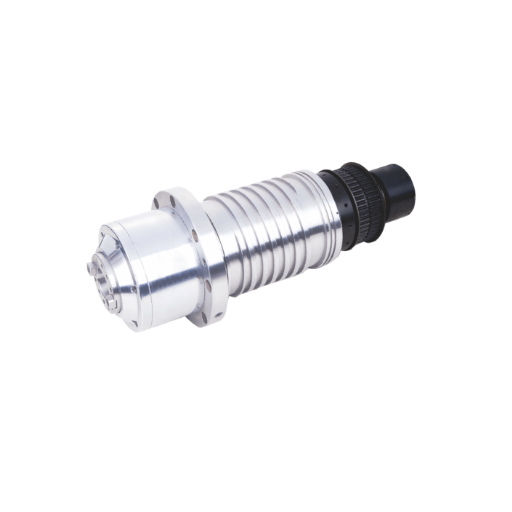
Matching the spindle type to the job
The classifications overlap. A single spindle can be integral-motor, ball-bearing, liquid-cooled and built for milling. The job tells you which combination to look for:
Heavy cuts in steel or other tough material: torque matters more than top speed. Look at belt-driven or high-torque milling spindles, such as the DGZX-28010/33 (S1 rated torque 420 Nm in Y and 107 Nm in delta; 630 Nm is an S6 curve value) or the 40–45 kW synchronous models, with a robust interface like BBT50 or HSK-A100.
Light, fast cutting with small tools: speed matters more than torque. Look at integral-motor spindles with small HSK or ER interfaces, from engraving spindles at 40,000–60,000 rpm up to dental and PCB units.
Fine surface finish and tight rotation accuracy: look at hydrostatic or air-bearing spindles. Haozhi hydrostatic grinding spindles are rated to sub-0.1 μm rotation accuracy.
Turning: pick a lathe spindle by bore, belt or motorized drive, and chuck or collet interface.
Not sure which row fits your machine layout? Send your layout and process to Haozhi's engineers and they can narrow the options.
Spindle vs. Servo Motor vs. Rotary Table: What's the Difference?
Beginners often mix these up because all three involve rotation.
Spindle: rotates the tool or workpiece continuously to cut. It is about speed and cutting torque.
Servo motor: drives or positions a machine axis, moving a slide or table to a commanded position. It does not cut. Compact AC servo motors and DC servo motors are typical axis drives.
Rotary table: turns or indexes the workpiece to a set angle between or during cuts. It adds an axis; it does not replace the spindle.
So the spindle motor and the axis servos are separate systems on the same machine. One drives the cut and the other positions it.
Other Meanings of "Spindle"
Car or truck: the stub the wheel hub and bearings ride on.
Textile: the rod that twists fibers into yarn and holds the wound thread.
Biology: the microtubule structure that pulls chromosomes apart during cell division.
In manufacturing, the term usually refers to the rotating machine-tool unit.
How to Choose a CNC Spindle: Quick Checklist
Work through these in order:
Speed range: what the tool diameter and process need.
Torque and power: what the heaviest cut on your list requires.
Tool interface: it must fit your tool holders and tool-change system. HSK, BT, BBT, ISO and ER holders are not interchangeable.
Bearing type: ball, air or hydrostatic, based on speed, load and accuracy.
Cooling method: air or liquid, based on duty cycle.
Mounting and machine fit: diameter, flange, length and cable or coolant routing.
When you ask any supplier for a quote, state your speed, torque, power, cooling type, interface and encoder requirements up front.
To compare spindles by drive, interface and application, browse the full catalog of CNC spindles and precision motion products. If your layout does not fit a catalog model, contact Haozhi with your requirements. Lead time depends on the model and how much customization it needs, so ask for a confirmed delivery date before you lock your build schedule.
FAQ
What is a spindle on a CNC machine, or in CNC?
A CNC spindle is the machine's main rotating unit: a shaft with its bearings, drive and tool or workpiece interface. It turns the tool on a mill or router and the workpiece on a lathe. Axis motors position the cut, while the spindle supplies the rotation that does the cutting. Programs control its speed in rpm.
What are the different types of CNC spindles?
They are usually grouped by drive (belt-driven, direct-coupled or integral-motor), bearing (ball, air or hydrostatic), application (milling, turning, grinding, dental, PCB and others) and cooling (air or liquid). One spindle can fall into several groups at once, such as a liquid-cooled, integral-motor milling spindle.
What is a spindle used for?
On a machine tool, a spindle holds and rotates a cutting tool or workpiece for milling, drilling, turning, grinding, routing or engraving. The same word appears in textiles, vehicles and cell biology. In CNC work, the spindle supplies the speed and torque the process needs.
What does a spindle do on a lathe vs. a mill?
On a lathe, the headstock spindle rotates the workpiece against a stationary tool. On a mill, the spindle rotates the tool against a stationary workpiece. The spindle is similar in both cases. What changes is which part spins and which interface holds it, usually a chuck on a lathe and a tool taper on a mill.
What is the difference between a spindle and a shaft?
A shaft is any rotating bar that transmits torque. A spindle is a shaft built for machining, with precision bearings, a tool or workpiece interface and controlled running accuracy. The word is also used for the whole assembly around that shaft, which is why spindle and shaft are sometimes used interchangeably.
What is a motorized spindle?
A motorized spindle, also called an electro-spindle or integral-motor spindle, has its motor built into the spindle body, so the rotor sits directly on the shaft with no belt or coupling. This allows compact designs and high speeds. The trade-off is that the motor's heat is generated inside the unit and has to be managed by cooling.
What is spindle runout, and why does it matter?
Runout is how far the tool or workpiece axis wobbles as the spindle turns, measured in microns. Excess runout shows up as poor surface finish, uneven tool wear and oversized holes. It comes from bearing condition, the tool holder and taper seating, and clamping force. Hydrostatic grinding spindles are among the lowest-runout designs, and Haozhi hydrostatic grinding spindles are rated to sub-0.1 μm rotation accuracy.
How long does a CNC spindle last?
There is no single figure, because bearing life drives spindle life, and bearing life depends on load, speed, preload, lubrication, contamination and heat. A spindle run within its rated speed and load, kept clean and properly cooled, lasts far longer than one that is crashed, overheated or run with contaminated air or coolant. Repair and rebuilding are common at end of bearing life.

 Home