How Much Do Linear Motors Cost?
Short answer: small catalog linear motors are listed at roughly $500 to $2,000 per unit. Industrial machine-tool motors with long magnet tracks, high continuous force and water cooling are priced by quotation, and the total depends on travel length and on the drive and feedback around the motor. Listings below were captured from public catalogs on October 13, 2026. Prices change, and these are snapshots of small-format parts, not benchmarks for CNC feed axes.
| Example | Observed listed price | Source |
|---|
| Parker I-FORCE ironless linear motor (310 series) | $495–$752 depending on configuration | e-motionsupply |
| Brushless linear motor | $1,129; stator alone $282 | OAV Labs |
| Tubular DC (voice-coil style) linear motor, 51 mm dia. × 165 mm | $1,931 for 1–4 units, falling to about $1,126 at 50–99 units | ElectroMechanicsOnline |
| General ranges in an industry article | about $300–$800 (lower tier); $800–$3,000+ (mid tier) | ITG Motor |
Three caveats apply:
Motor types are mixed. The tubular listing has a 133 mm stroke and is a voice-coil-style actuator. That is a different product from a flat motor running along a multi-meter magnet track.
Prices exclude the rest of the axis. None of these listings include a drive, encoder or bearings. The tubular unit's own listing states that the customer supplies a linear bearing.
Quantity matters. The tubular motor's price falls about 42% between 1–4 units and 50–99 units.
A compact flat motor to specify against is the DLMF-01W compact flat linear motor. Pricing for Haozhi motors is by quotation, issued against your force, travel and accuracy targets. 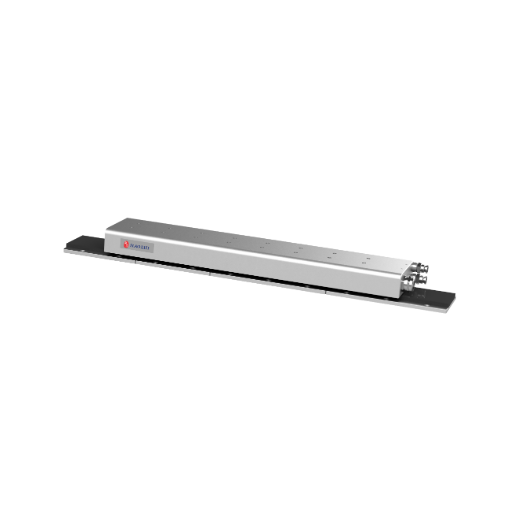
Why Are Linear Motors So Expensive?
Linear motors are direct-drive parts: the coil and magnet-track construction leaves no gearing or screw to absorb tolerance errors. The motor, its feedback and the structure around it all have to be precise. Five drivers account for most of the price, and each comes with a question worth putting to a supplier.
Magnets and magnet track length
The magnet track is the long, fixed half of the motor. Its cost scales with travel, so a 2 m axis carries a very different magnet bill from a 200 mm one. This is the main reason long axes get expensive quickly. Ask: is the track priced per segment, and how are the joints between segments handled?
Coil design and iron-core vs. ironless construction
Iron-core designs are generally the more affordable route to high thrust, but they run hotter and show cogging. Ironless designs are built for very smooth motion and usually cost more because of the more complex coil and magnet assembly. The right choice depends on your smoothness requirement, so treat it as a trade-off, not a quality ranking. Ask: what force do you get per dollar of motor at your duty cycle, not at peak?
Drive, controller and feedback
A linear motor cannot run without a servo drive and a position feedback device. At micron-level resolution, the linear encoder can be a large share of the axis cost, and tighter resolution pushes it higher. Ask: is the encoder scale priced for the full travel length?
Cooling and thermal management
High continuous force generates heat directly at the axis. Air-cooled designs cost less, while water-cooled designs hold thrust longer but add plumbing, a chiller connection and thermal isolation work. Haozhi's catalog includes the DLMF-04W high-thrust, water-cooled linear motor, which shows how cooling gets built into motor selection. Ask: what is the continuous force with and without cooling?
Low volumes and tight tolerances
Linear motors are built in small runs, and the air gap between coil and magnets has to be held tightly. The tubular unit's volume price break above is a clear example: the same part costs far less per piece at higher quantity. Ask: at what annual volume does the price break?
What a Complete Linear Motor Axis Costs
The motor is only one line in the budget. A full axis estimate has these lines:
Motor: forcer (coil assembly) plus magnet track
Servo drive and controller
Linear encoder (scale plus read head)
Guides or rails
Cooling hardware, if the duty cycle needs it
Cable management, such as an e-chain
Mounting structure and flatness requirements
Commissioning and tuning
As a formula: Axis cost = forcer + (track length × cost per meter of track) + drive + encoder + guides + cooling + structure and commissioning Public price lists for CNC-grade encoder scales and servo drives are not reliably available, so each is a separate quote line. Cost per meter of track varies with magnet grade and force class, so it also comes from the supplier.
Worked example: a 500 mm air-cooled axis
| Line item | What to specify | Cost basis |
|---|
| Forcer | Continuous and peak force at your duty cycle | Small catalog motors list at about $495–$1,931; CNC-grade is quoted |
| Magnet track | 500 mm of travel plus forcer length, as segments | Per-meter track quote |
| Servo drive | Matched to motor current and bus voltage | Quote |
| Linear encoder | Resolution and 500 mm scale length | Quote |
| Guides | Rail length and accuracy class, see linear rail cost | Quote |
| Cooling | Air only: heat-sink or fan, no chiller | Usually small |
| Cable management and structure | E-chain, flat mounting surface | Quote |
| Commissioning | Tuning and homing | Quote |
Axis figures are estimates; get quotes. Only the forcer line has public price anchors, and they come from small-format listings. Drive costs follow rotary-servo pricing, where servomotor cost rises with torque class and feedback type. To price your own axis line by line, request an itemized full-axis quote covering motor, track, drive, encoder and cooling. 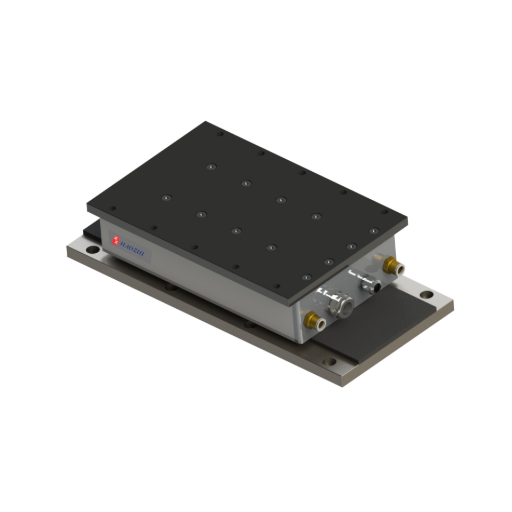
Linear Motor vs. Ball Screw: Cost Comparison
On purchase price, a ball screw axis is usually cheaper. It needs a rotary servo and drive, a coupling, a screw and nut, support bearings and guides, all built from mass-produced parts. Haozhi's precision ball screws are one example. Public prices for a comparable ball-screw axis are not consistently listed, so request a parallel quote for the same 500 mm of travel and the same accuracy target. The linear motor trades a higher initial price for a simpler mechanical path: no screw wear, no coupling and no backlash to compensate. Whether that trade pays back depends on the application.
| Axis priority | Cost direction | Why |
|---|
| Low-cost, moderate-speed axis | Ball screw wins | Lower initial price, familiar components |
| High-throughput axis | Linear motor often wins | Acceleration and cycle time drive the economics |
| Long travel at moderate speed | Ball screw usually wins | Magnet track length drives the linear motor price up |
| Precision positioning without backlash | Linear motor competitive | No mechanical lash to compensate; the encoder is the main cost |
For high-throughput or no-backlash axes, compare high-speed CNC linear motor feed systems against a screw-driven design that delivers the same throughput.
When the Premium Pays Off, and When It Doesn't
Where the premium tends to pay off
Machines where speed or acceleration sets output, such as inspection and semiconductor handling
Axes where no-backlash positioning matters more than the hardware price
Applications where wear parts and maintenance on a screw axis are a real operating cost
Where it usually doesn't
Low-duty axes that move occasionally
Long strokes at moderate speed, where track cost dominates
Tight-budget machines where the extra drive and encoder cost can't be recovered
How to budget in three steps
Define continuous force, peak force, travel and accuracy targets before asking anyone for a price.
Request quotes with the full axis scope (track, drive, encoder, cooling), not motor-only prices, so quotes compare like for like.
Compare the total cost of ownership against a ball-screw alternative, using your own duty cycle and maintenance records.
To price a specific axis, send your targets through Request Technical Consultation.
Frequently Asked Questions
What is the linear motor price?
Small catalog units are listed from about $495 up to roughly $1,931. Industrial CNC-grade linear motors with long magnet tracks are quoted per project. Compare complete axis quotes, because the drive, encoder and track add to the motor price.
How much does the magnet track cost per meter?
No reliable public figure exists, and any single number would mislead. Track cost per meter depends on magnet grade, force class and how the track is segmented. Ask suppliers to quote the track separately from the forcer, with the cost per segment and the joint method stated, so you can scale it to your travel length.
Why are linear actuators so expensive, and what do they cost?
Direct-drive linear actuators use precision magnets, tight-tolerance assemblies and drive electronics, and they are built in low volumes. Screw-driven actuators reuse mass-produced rotary motors and screws, so they cost well below direct-drive units. No single price applies without a stroke, force and feedback requirement.
How expensive is a servo motor?
It varies with torque class and feedback type; see servomotor cost or compact examples like the MSA axial-flux servo motors. A linear axis needs a servo drive either way.
Do linear motors get cheaper in volume?
Yes. One tubular linear motor listing drops from $1,931 each at 1–4 pieces to about $1,126 each at 50–99 pieces. Machine builders ordering in OEM quantities should ask for break points in their quote and compare them against annual forecasts.

 Home