By the Haozhi technical content team, Guangzhou Haozhi Industrial Co., Ltd.
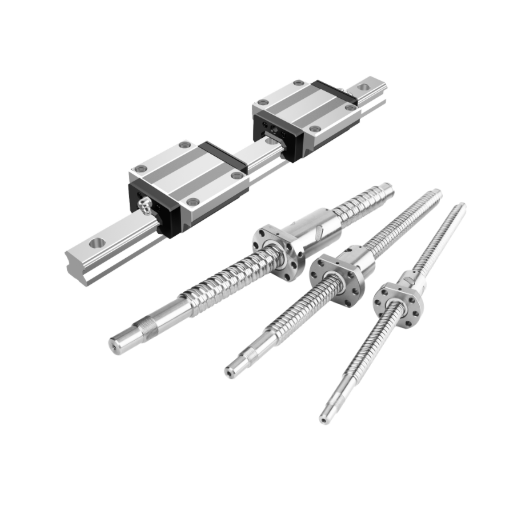
How a Ball Screw Works
Recirculating steel balls roll in matching grooves between a threaded shaft and a nut. Rolling replaces the sliding friction of a lead screw. That one change drives the advantages and drawbacks.
| Ball-nut part | Job |
|---|
| Screw shaft | Helical raceway, ground or rolled |
| Balls | Carry thrust by rolling |
| Nut and return path | Recirculate balls; split or oversized-ball designs allow preload |
| Wipers | Keep chips out of the ball track |
Ball Screw Advantages
High efficiency: typically around 90%, against roughly 20–40% for Acme lead screws (general industry ranges).
Lower drive torque: required torque is T = F·P / (2π·η). For 5,000 N of thrust on a 10 mm lead, that is about 8.8 N·m at 90% efficiency and about 26.5 N·m at 30%. The example ignores bearing and preload drag. Less torque means a smaller motor.
Precision and repeatability: common JIS lead-error classes are C3 (about ±8 µm per 300 mm), C5 (about ±18 µm) and rolled C7 (about ±50 µm). A preloaded nut removes backlash. Confirm grades with your supplier.
Axial rigidity and load capacity: the balls carry thrust with little deflection.
Long life and speed: both hold when the screw is lubricated and protected.
What Is the Disadvantage of a Ball Screw?
The main disadvantages are that ball screws are back-drivable (they do not self-lock), sensitive to contamination, and costlier than lead screws. Critical speed, noise and preload wear also matter, and each has a fix.
Back-Driving and No Self-Locking
Low friction lets a vertical load spin the screw backward when power is cut. Fix: vertical axes need a brake. Use a brake motor or servo brake, a counterbalance, or a self-locking stage such as a worm drive.
Contamination and Lubrication Sensitivity
Chips, dust and coolant shorten life. Fix: wipers, bellows or telescopic covers, and a set lubrication schedule.
Critical Speed, Whip and Length Limits
Long, slender screws whip at a critical rotational speed, and critical speed falls with the square of unsupported length. Doubling the span cuts it to roughly a quarter. Long screws under compression can also buckle. Fix: a larger diameter, a higher lead, fixed-supported or fixed-fixed end mounting, or a rotating-nut design.
Cost, Noise and Preload Wear
Precision grinding and recirculation parts raise cost. As a rough rule, ground screws often cost two to three times a rolled screw of similar size, though quotes vary. Rolled is cheaper but less accurate. Recirculating balls are also noisier than plastic or bronze nuts. Preload adds stiffness but also drag and heat, and wear can erode it, so check backlash periodically.
Ball Screw vs Lead Screw: Which Is Better?
| Ball screw | Lead screw |
|---|
| Efficiency | Around 90% | About 20–40% (Acme) |
| Precision | Preloadable, low backlash | Higher backlash |
| Self-locking | Usually no | Often yes |
| Cost | Higher | Lower |
| Noise | Noisier | Quieter |
| Contamination tolerance | Needs protection | More forgiving |
| Best fit | Precision, duty cycle, speed | Light duty, vertical holding, tight budgets |
For ball screw vs lead screw on CNC machines, ball screws are the default for CNC axes. Lead screws suit hobby or low-duty builds.
When to Use a Ball Screw (and When Not To)
Use one when you need precision positioning, continuous duty, high speed or a CNC axis, and the screw can be kept clean or covered.
Skip one when you need self-locking without a brake, the environment is dirty and unprotected, or loads are light and the budget is tight. For very long, fast strokes, consider rack and pinion or linear motors.
Sizing and nut selection start in the ball screw guide. Ready to match a screw to your axis? Browse Haozhi's precision ball screw range or talk to our engineers.
Related components: HAR ball linear guides, HBR roller guideways, the BL 30 servo motor and ER precision collets for tool holding.
FAQ
What is the disadvantage of a ball screw?
Ball screws can be back-driven because they do not self-lock. They are also sensitive to contamination and cost more than lead screws. Critical speed limits on long screws and noise count too. Brakes, covers and correct end supports manage most of these.
How long do ball screws last?
Life depends on load, speed, lubrication, contamination and preload. It is usually rated as L10 life, in revolutions or travel distance. Compare the manufacturer's dynamic load rating with your actual load, since no single hour or distance figure applies to every screw.
Which is better, a ball screw or a lead screw?
Ball screws are better for precision, efficiency and continuous duty. Lead screws are better for low cost, quiet running and self-locking in light-duty or dirty settings. Choose based on duty cycle, required accuracy and whether the axis is vertical.
Are ball screws back drivable?
Usually, yes. Their low friction lets an axial load spin the screw, especially at higher leads. Vertical axes therefore need a brake, a counterbalance or a self-locking stage. Horizontal axes typically hold position through the motor and drive.

 Home